
Fire point (ASTM D92)≥ 260 °C
Spray flammabilityISO 15029-2: Pass
Viscosity46 mm²/s @ 40 °C (±10%)
Vane pump wearASTM D2882: In-spec
Customer
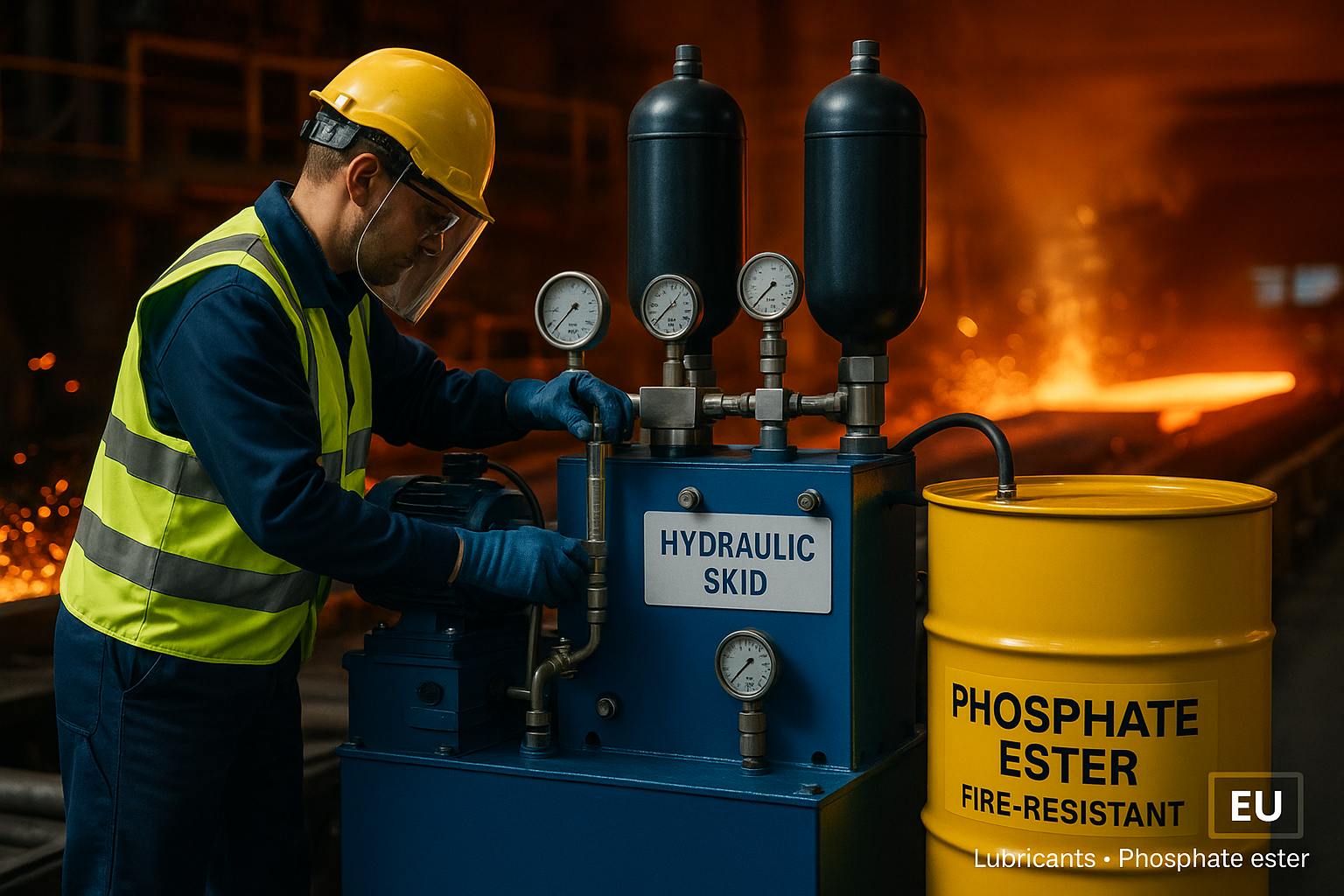
European steel mill with hot-zone hydraulics. Sought higher fire safety and cleaner operation vs. water-glycol (HFC).
Challenge
- Improve fire resistance in spray scenarios around torches/ladles.
- Maintain pump life, seal compatibility and paint integrity.
- Minimize downtime during conversion from HFC.
Approach
Benchmarked HFDR fluids; selected a triaryl phosphate ester base with AO/anti-foam/MDI package. Ran a staged flush, filter upgrade and seal audit before line fill.
Formulation window
| Component | Function | Treat | Notes |
|---|---|---|---|
| Triaryl phosphate ester | Base stock (fire-resistant) | 70–85% | High fire point; excellent lubricity. |
| Phenolic/amine AO | Oxidation control | 0.5–1.0% | Thermal stability in hot zones. |
| Metal deactivator | Cu/Fe passivation | 0.02–0.05% | Protects in bronze bushings. |
| Acid scavenger | Acid number control | 0.2–0.5% | Maintains TAN during service. |
| Antifoam (silicone-free) | Air release/foam | 10–50 ppm | Fast air release per ISO 9120. |
| VM (optional) | Shear stability | 0–5% | Hold ISO 46 in heat. |
Processing & testing
- Conversion: Drain HFC, solvent/compat flush, new filters (β200 ≥ 12), dry-out to ≤ 500 ppm H₂O.
- Compatibility: Verify seals/paints (NBR/FKM preferred; avoid natural rubber/PU where flagged).
- Monitoring: ISO 4406 cleanliness 17/15/12 or better; TAN, water (KF), air release, foam.
- Bench tests: ASTM D92 fire point, ISO 15029-2 spray, ASTM D2882 pump wear, ASTM D2272 RPVOT.
Results
Achieved spray-fire Pass, higher fire point, stable viscosity and low pump wear. Leak cleanup improved; no paint softening on audited components. Mill approved HFDR for broader rollout.