
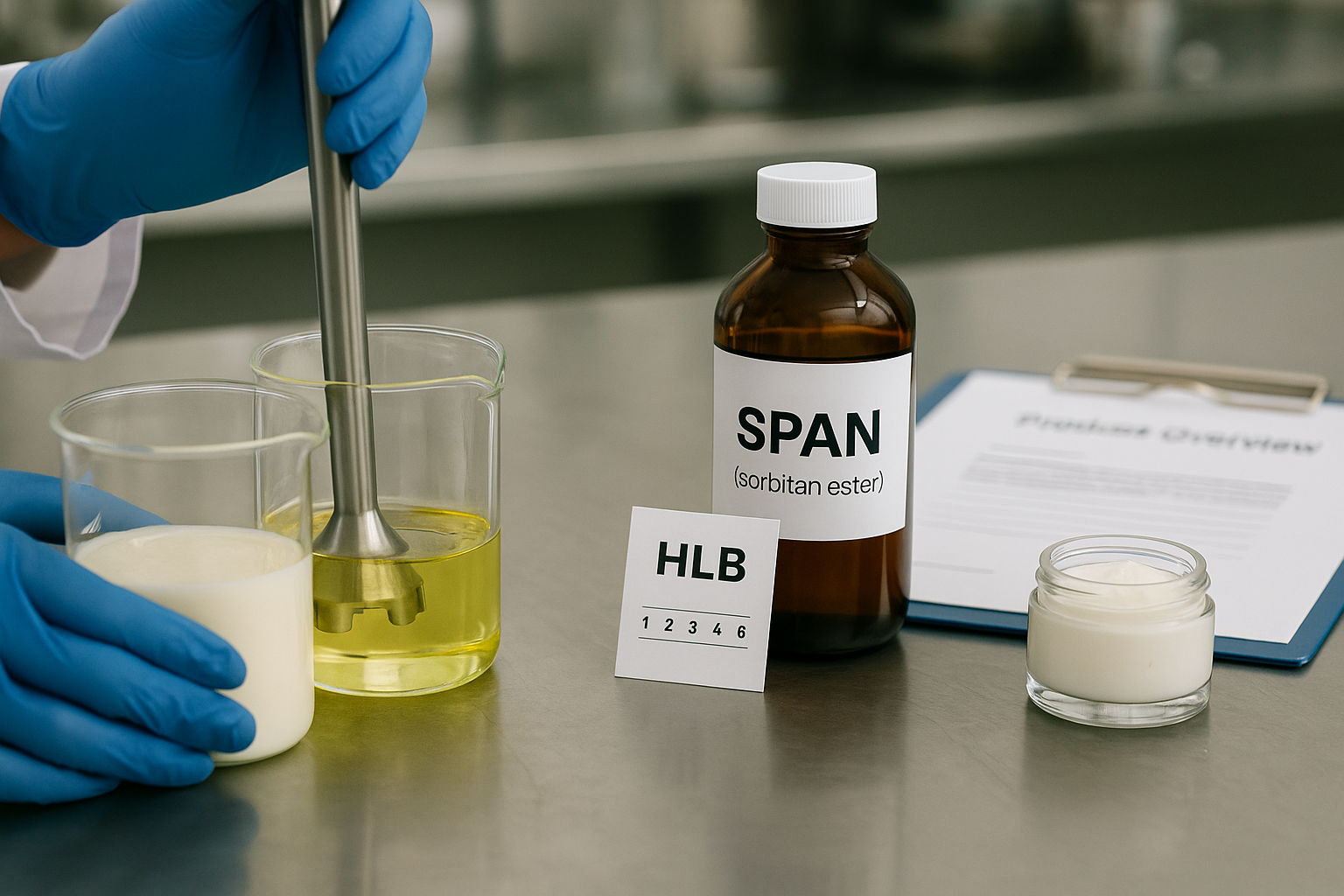
SPAN emulsifiers are sorbitan fatty acid esters with low HLB values suitable for water-in-oil systems, viscosity building, and co-emulsification with polysorbates (TWEEN) to hit precise HLB targets.
FunctionLow-HLB emulsifier / co-emulsifier
HLB range~4–8 (grade dependent)
FormsViscous liquid / waxy pastilles
DocsSDS / COA on request
Grades & indicative HLB
| Grade | Chemistry | HLB (approx.) | Form @ 25 °C | Notes |
|---|---|---|---|---|
| SPAN 20 | Sorbitan monolaurate | ~8–9 | Soft solid / paste | Higher HLB in SPAN range; O/W co-emulsifier |
| SPAN 60 | Sorbitan monostearate | ~4–5 | Waxy solid (pastilles) | Structurant; W/O creams, antifoam aid |
| SPAN 80 | Sorbitan monooleate | ~4–5 | Viscous liquid | Good oil solubility; disperse aids |
Typical applications
- Personal care: W/O creams, balms; co-emulsifier with polysorbates
- Food & nutraceutical (subject to final compliance): emulsification and anti-crystallization
- Agro/HI&I: dispersion aids and wetting in hydrocarbon systems
- Inks/coatings: pigment wetting; viscosity control
Formulation guidance
- HLB balancing: Pair SPAN with TWEEN grades to hit target HLB for O/W systems.
- Use levels: Typically 0.5–5% depending on phase ratio and viscosity.
- Processing: Pre-disperse in oil phase; heat gently (~55–70 °C) to aid dissolution.
Handling & storage
- Store sealed, clean and dry; protect from moisture and excessive heat.
- For solids/pastilles, warm to melt before metering; avoid water ingress.
- Check elastomer compatibility for high-temperature service.
Regulatory: Supplied with SDS/COA. Food or pharma
use depends on final formulation and jurisdiction—request the
regulatory dossier for your application.
Documentation & samples
Change log
- — Initial note published.